





























































































































































































































































































USF Member Organisations
Click on a logo to find out more about each of organisation.

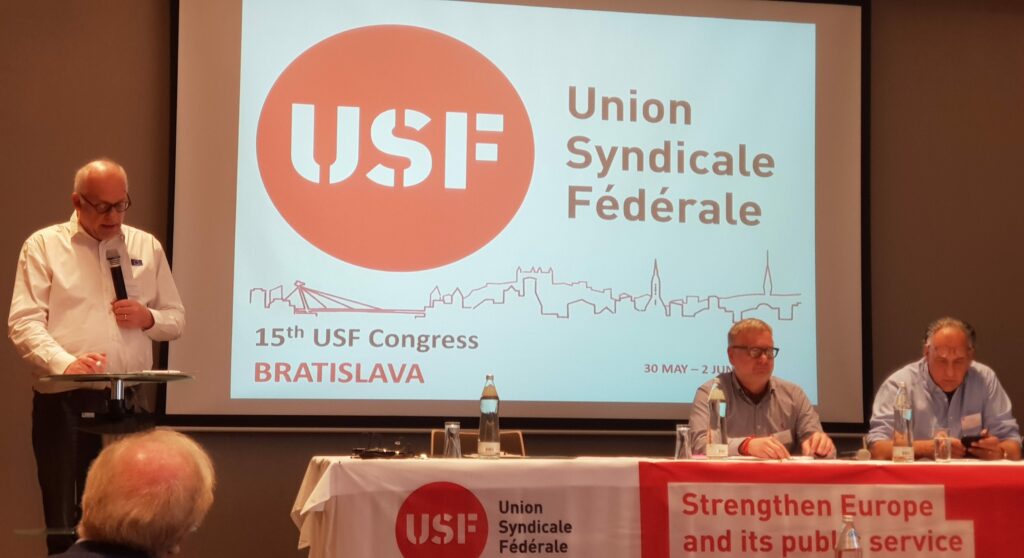
Union Syndicale Fédérale was created more than 50 years ago. It brings together trade union organisations under the banner of unity and solidarity with the world of work. It currently brings together 21 "Union Syndicale" organisations based in various European and international public service workplaces.
Click on a logo to find out more about each of organisation.













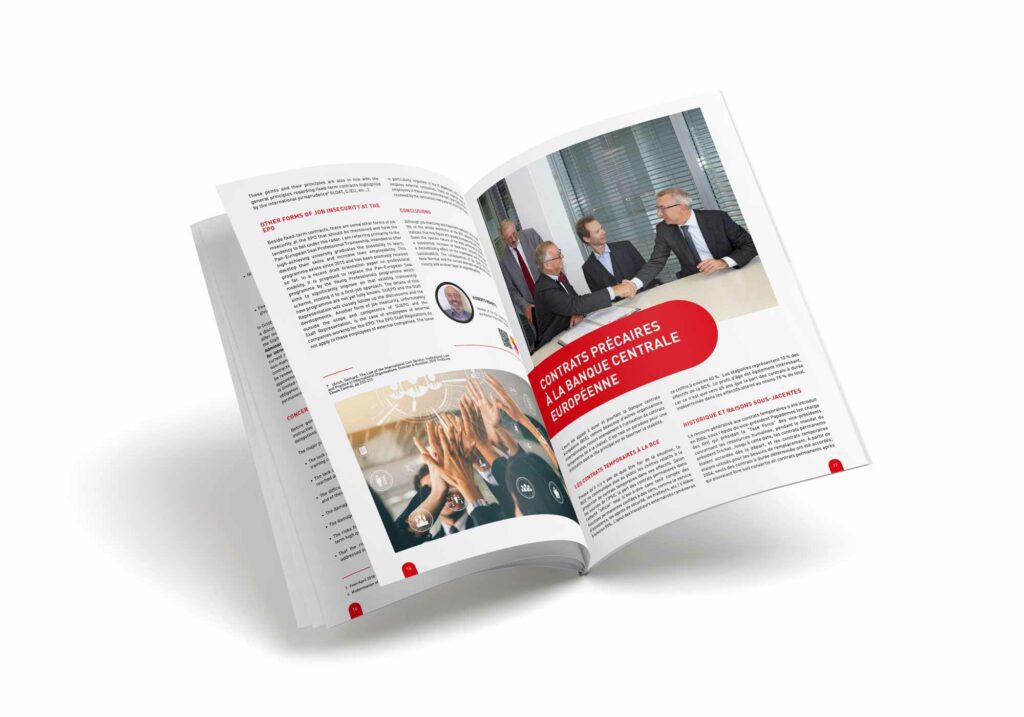
The magazine of the European and International Public Service.
A publication for the union syndical communities to share information, opinions, and views with their comprehensive, insightful, and in-depth knowledge of trade unions and the world of European public service.
LEGAL NEWSLETTER OF UNION SYNDICALE
Staff Matters is a newsletter to keep you regularly informed about latest developments in EU case law on staff matters and other useful legal news relevant for staff
Staff who report harassment, misconduct, or irregularities must be protected from retaliation. In our latest legal newsletter, we look at a recent case involving an Accredited Parliamentary Assistant (APA) who sought protection after reporting harassment and alleged financial irregularities, only to face transfer and eventual discharge from his duties.
Where Does Workplace Conflict End and Harassment Begin?
Where is the line between difficult workplace relationships and psychological harassment?
Can harassment happen collectively, or even through silence and inaction? Can someone be part of harassment without actively participating? New EU case law provides surprising answers and reinforces the duty of care owed to staff.
Read more in our latest analysis.
The Court annulled an appraisal report. The applicant had requested assistance for alleged harassment and the administration opened an inquiry against the reporting officer. That inquiry was closed, but its outcome was not yet known at the time of the appraisal. The case is enlightening on the principle of objective impartiality in the context of the appraisal procedure, the allocation of reporting responsibility by the institutions in the appraisal exercises, the potential need of reporting officers to recuse, and on the effect of requests for assistance and administrative inquiries on appraisals.
The judgment handed down by the Court of Justice on January 29, 2026, reaffirms a fundamental principle: European Union institutions must clearly state the reasons for their decisions. In this case, the refusal to reclassify an official was overturned due to insufficient reasoning. This judgment emphasizes that institutions cannot remedy a lack of reasoning after the fact and must always respect the rights of the defense and the principle of equality of arms, thereby strengthening transparency and accountability within the European Union administration.
In this newsletter, we present a judgment by which the Court annulled an appointment for a senior management position. The President of the Commission should have either conducted the selection interview herself or (as internal rules warrant) duly justify the delegation of that interview to her Head of Cabinet by referring to “imperative service needs”. Failure to comply with this – in the view of the Court – amounts to a breach of an essential procedural requirement that rendered the appointment of the applicant’s competitor liable to annulment.
The Court of Justice (ECJ) set aside a judgment of the General Court and annulled the decision of EUIPO, which had rejected a job application of the appellant on the grounds that she was originally an official of the Commission. The case clarifies that a transfer application can be regarded as an application seeking to fill a vacant post. The seconded staff member’s file responding to an internal vacancy notice should have been taken into account. This judgment has the potential to facilitate interinstitutional mobility.
In a judgment delivered in October 2025, the General Court emphasizes again the importance of the principle of impartiality. There must be sufficient guarantees to exclude any legitimate doubt as to possible bias of the decision-makers and persons involved in proceedings. In the case decided, objective impartiality has not been complied with, also because two persons working in the same unit as the applicant (colleagues) had been in charge of conducting an administrative investigation against the applicant, which later led to the sanction of a warning.
The Court of Justice clarified that, under Article 90(2) of the Staff Regulations, the act to be challenged depends on its substance and context, not its form, meaning even emails labeled as “for information only” may constitute adverse decisions. Failure to contest such acts can render subsequent actions inadmissible. Substantively, the Court confirmed that a child tax abatement ends at the latest on the child’s 26th birthday and that internal Commission directives cannot override binding provisions of the Staff Regulations.
Union Syndicale helped three US members in AST 7 to take legal action. The Court of Justice has now ruled in our favour, providing clarification for staff across all EU institutions. This newsletter presents a recent judgment by which the Court has annulled a non-promotion decision of the Council. The Council erred in law when relying on an alleged discretion to reduce the number of vacant posts (i.e. opportunities for promotion) in the promotion exercise.
Court annuls termination of contract. Clear establishment of the facts is required both for dismissal and in disciplinary proceedings. We look at the termination of a contract of indefinite duration. The institution is not obliged to start disciplinary proceedings instead of choosing an Art. 47 (c) (i) CEOS termination of contract. However, in the recently decided court case, the Commission was not able to clearly establish the facts underlying the claimed destruction of trust in the work relationship towards the applicant.
This newsletter is about the important subject of invalidity, at the example of a recent judgment of the Court of Justice which confirms that the term invalidity in the context of the entitlement of staff to an invalidity allowance can only be interpreted as an incapacity to fulfil the duties within the own institution.
An important judgment of the Court of Justice (ECJ) on the pension rights of contract staff and on effective judicial protection. The benefits of the transitional regime for staff other than officials who had already contracts before 2004 or 2014 also apply to the many colleagues who cannot show to have worked in “functional continuity” (due to various functions on the basis of various contracts).
The European Court of Justice (ECJ) ruled on the term “unauthorised absence” of an official in the sense of Art. 60 SR. As the Court decided, “absence” means physical absence. The provisions for disciplinary measures shall not be bypassed by applying the “unauthorised absence” concept in a too broad sense.
A case decided by the General Court in which it annulled the decision not to promote an official. The promotion procedure was vitiated because it took into account also earlier reports relating to the probation period of the applicant, instead of being solely based on appraisal reports.
This newsletter treats a very recent interim measure handed down by the General Court in which it ordered that the EIT (in Budapest) has to allow the applicant to do telework from her place of origin in Germany, until the time of lifting of the restrictions linked to the health crisis imposed by the authorities in Germany and Hungary.
This newsletter treats a case decided by the General Court relating to the recognition of the occupational nature of a disease. The medical opinion issued by the Medical Committee was judged irregular, because the Committee was not able to examine all the available documents.
In this newsletter, we report on a recent decision of the General Court on reimbursement of medical expenses. For the rental of a medical device, the appointing authority – in the absence of an explicit reimbursement ceiling in the applicable rules – chose to apply the same ceiling that is prescribed for the purchase of that device.
This newsletter deals with a recent decision of the General Court on the question whether the law allows a superior to be an impartial appeal body for review of the appraisal report of a staff member, in case the same superior had played an important role in setting up the respective appraisal report before, as a reporting officer.
This newsletter treats a recent case on contract termination during sick leave. The General Court annulled the dismissal decision of the European Environment Agency and awarded certain allowances to the applicant as well as compensation of 6,000 Euro for non-material damage suffered.
This newsletter is dedicated to the subject of discrimination based on language. It presents two recent judgments of the Grand Chamber of the European Court of Justice. Differences of treatment based on language are, in principle, not allowed in the procedures for selecting staff for the EU institutions.
This newsletter on a decision of the General Court of 8 May 2019 treats a question with considerable practical significance for all staff approaching or having reached their retirement age. The Court decided that it is not allowed to place an official on leave in the interests of the service if the person has already reached his/her pensionable age.
This issue deals with a recent decision of the Court on pension rights, particularly on the question of whether there is a continuity of service for the EU and – related to this – whether previous, more beneficial, provisions on pension apply, although the official during most of her career has not worked in the Commission, but within EU agencies.
This issue will focus on the invalidity allowance. The applicant in case RI / Council, having worked for several years as a translator for the Council, suffered from health problems at her left hand. The procedure to acknowledge her illness as an occupational disease was successful, while the Council refused to acknowledge it.
We will focus on the assistance that is – or should be – given by institutions to victims of harassment. A Member of Parliament (MEP) requested the employing authority to terminate her assistant’s (the applicant of the case) contract by stating that the assistant, without permission, had not come to work for one week.
We are committed to providing the best service to our members, including free legal advice from our lawyers on all matters relating to your professional or private life, consultations with our tax expert and free webinars/training courses for EPSO competitions.


The whole history of Union Syndicale is based on solidarity. Solidarity between colleagues, to help each other. But also, to make ourselves heard together, in the face of the employer, in the face of abuses of power, in the face of everything that jeopardises the European Union’s public service.