In April 2012, four contract-staff members at the Court of Justice discovered that, by applying to have their national pension rights transferred to the EU pension scheme (IN transfer), they had, in fact, lost those rights altogether. Nobody working in the relevant unit had informed them that Article 77 of the Staff Regulations provides for two methods of calculating the pension: that, apart from the first method (Article 77, second para.), which takes into account the pensionable years resulting from the transfer, there is a second method (Article 77, fourth para,) which does not take such years into account. The second method constitutes a ‘safety net’, known as the minimum subsistence figure rule. 🔗 Read our article in Agora No. 94.
From Law …
In the Barroso Truta judgment, handed down in an action supported by EPSU-CJ, the General Court, whilst unable to rule in favour of the applicants, nevertheless indicated a course of action for the future: once their pension entitlements were settled, they could bring an action based on the European Union’s unjust enrichment.
This principle was enshrined in the Masdar judgment of the Grand Chamber of the Court. In that judgment, the Court recognised that unjust enrichment, although not expressly provided for in the Treaties, falls within the scope of the principles of EU law. The Barroso Truta judgment drew its authority from the Masdar judgment, which, in turn, is a leading case within the EU case-law.
… to legal engineering
This has not, however, prevented an avalanche of subsequent judgments, notably the KY judgment (under her human name, Navratilova) v CJEU – from overturning, through the surreptitious method of Newspeak, the principle established by the Masdar judgment and the remedy envisaged in the Barroso Truta judgment, which constitutes the application of the Masdar judgment in the specific field of IN transfers, where the additional pensionable years (following an IN transfer) were not ‘taken into account ’ (when the person’s entitlements were settled).
The diagram below illustrates, step by step, the dual calculation of the pension in one of the simplest cases.
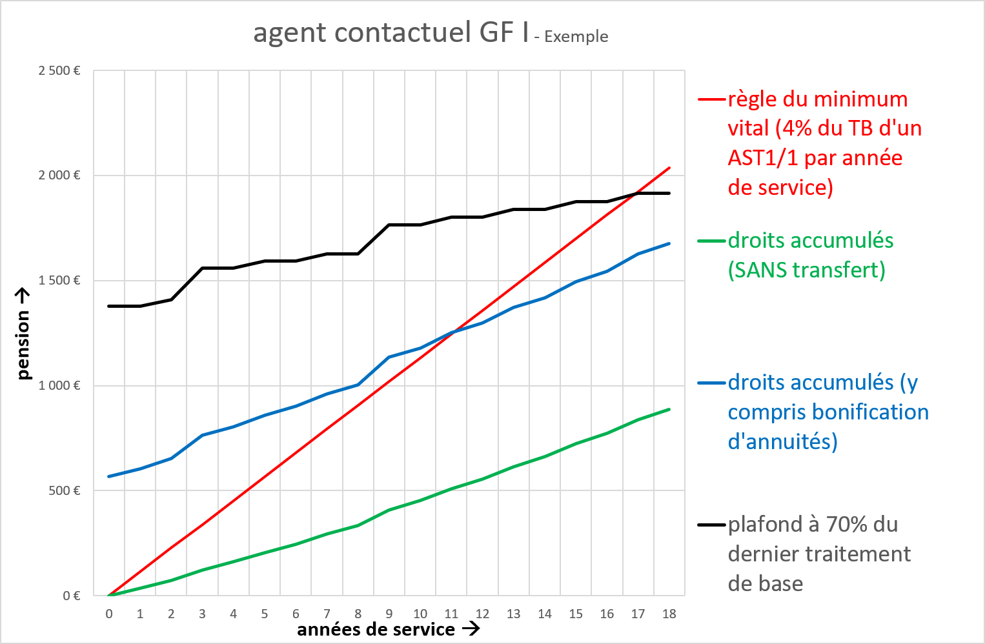
If the person concerned does not transfer their national pension rights, the first calculation (green line) starts from zero, as does the second calculation, which corresponds to the minimum subsistence figure rule (red line). If the second calculation results in a higher amount, this is the one that determines the EU pension. The ‘safety net’ then fulfils its role in full: the person concerned receives an EU pension whilst retaining their national pension rights.
However, if the person concerned agrees to the transfer, they immediately lose their national pension rights. The additional pensionable years obtained in this respect shifts the initial calculation from the green line to the blue line, which is higher than the green line. However, when the minimum subsistence figure level (the red line) gradually absorbs all or part of those additional years, those years have no effect, or only a partial effect, on the amount of the pension ultimately paid.
In this situation, according to the actual wording of the Barroso Truta judgment (para. 104), the capital transferred corresponds to ‘the additional pensionable years not taken into account for the calculation of their retirement pension’.
Thus, the additional pensionable years, which represent the equivalent of national pension rights relinquished at the time of the transfer, are once again rendered ineffective when the EU pension is calculated.
However, the expression ‘taken into account’ has always been used to mean an effective and positive contribution to the final outcome of a transaction.
The KY judgment and subsequent judgments have, however, altered the meaning of this concept. According to this interpretation, the additional pensionable years are deemed to be ‘taken into account’ as soon as they are included in the calculation under the second para. of Article 77 of the Staff Regulations, even if the amount resulting from that calculation is ultimately neutralised by the higher amount resulting from the application of the fourth para. of that article.
According to this line of reasoning, the additional pensionable years are still supposed to be ‘taken into account’, even though they have no effect on the amount of the pension actually paid. A staff member despoiled of their national pension will therefore have to make do with an EU pension which they would have received in any case, even without a transfer. Their transferred entitlements have thus yielded no actual benefit, whilst being deemed to have been ‘taken into account’ in a component of the calculation whose result was ultimately neutralised when the entitlements were settled.
This line of reasoning is merely the first link in a chain, which, through a shift in meaning, ultimately serves to eliminate any possibility of reimbursement for transferred pension entitlements.
Breaking the deadlock
Case law, having thus abruptly broken with the Masdar and Barroso Truta judgments – which are now interpreted through the lens of the KY judgment – has reached an impasse. It gives precedence to budgetary considerations over the effectiveness of the legal principles established by previous case law.
EPSU-CJ intervened of its own motion in Case C-835/24 P, PT (under her human name, Lahoz) v Commission, but only at the appeal stage, and therefore too late to be able to submit the evidence in its possession in the proceedings.
The abuses that occurred in the early years following the 2004 reform – when staff were not informed of the existence of the minimum subsistence figure rule and were advised, or even encouraged, by their administration to sign transfer proposals ‘for agreement’ (‘pour accord’) – have left a gaping wound for those affected and a black mark on the EU institutions.
*
In his Opinion in Case C-835/24 P, Advocate General Biondi proposes that the appeal be dismissed. It is now for the Court to rule on the matter.
His Opinion, however, opens a window by acknowledging that ‘the outcome of the statutory mechanism may appear unsatisfactory from the perspective of the individual staff member whose transferred pension rights prove to be economically ineffective’, whilst specifying that ‘any assessment of the appropriateness of corrective measures depends on regulatory choices that fall outside the scope of the Court’s jurisdiction’.
EPSU-CJ, for its part, does not call for the introduction of an automatic reimbursement of the portion of the transferred capital that has had no effect on the pension. It calls for the IN-transfer scheme to be applied properly, which presupposes that the ‘discretion’ granted to staff members as to whether or not to transfer is exercised in an informed manner, in particular through the provision by the administration of prior and relevant information on the existence and consequences of the minimum subsistence figure rule.
Institutions must settle the burden of the past by seeking solutions for staff members who have been wronged by transfers, finding themselves despoiled of their pension rights acquired prior to entering EU service, due to lack of essential information being provided to them.