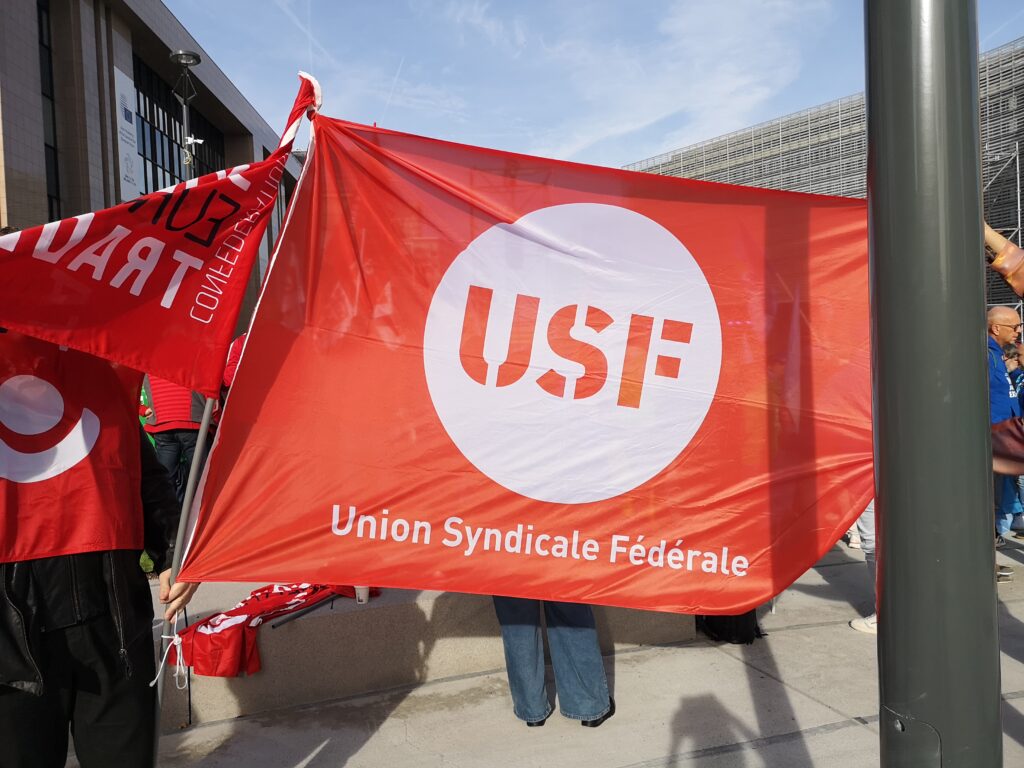
The USF Federal Committee adopted its position on Recommendations 7 and 8 of the Large-Scale Review concerning EU Decentralised Agencies on 26 September, ahead of the hearing with Commissioner Serafin. The USF opinion while recognising the importance of efficiency and cooperation, highlights the need to carefully assess proposals for agency consolidation, particularly those affecting agencies with fewer than 150 staff. The position emphasises the importance of social dialogue, protecting staff rights and preserving the expertise and knowledge that contribute to the agencies’ vital work for the EU.
UNION SYNDICALE FÉDÉRALE (USF) Position Paper
Subject: The Large-Scale Review (LSR) Recommendations on Decentralised Agencies (Recommendations 7, 8) — Safeguarding Staff, Knowledge and Institutional Capacity
- Introduction
Union Syndicale Fédérale has taken note of the Large-Scale Review’s recommendations concerning the landscape of the EU’s 35 Decentralised Agencies (DAs), in particular Recommendation 7 “Consolidate the number of DAs” (consolidation through mergers and, where appropriate, discontinuation), Recommendation 8 “A restrictive approach to new DAs “ (a moratorium on new agencies),
USF recognises that the Commission and the co-legislators have a legitimate interest in ensuring that the DA landscape is coherent, efficient and fit for purpose, and that genuine synergies between agencies operating in related policy fields should be explored. However, USF is not prepared to accept that this exercise be conducted, or perceived by staff, as a cost-cutting or headcount-reduction exercise carried out at the expense of the approximately 15,000[1] staff members currently employed across the DA network — officials, temporary agents and, in particular, the many Contract Agents whose employment security is already structurally weaker.
USF sets out below the principles that must govern any implementation of Recommendations 7and 8, and raises specific concerns about the methodology underpinning the “small agency” threshold used to justify consolidation.
- Core Principle: No Job Losses as a Result of Consolidation
USF’s starting position is unambiguous: no member of staff — official, temporary agent or contract agent — should lose their job, income, pension continuity or career prospects as a direct or indirect consequence of a merger, partial merger, pooling of services, or discontinuation of a Decentralised Agency.
Restructuring exercises of this scale inevitably generate anxiety among staff and their families, many of whom have relocated internationally, often more than once, to take up their positions, and whose spouses/partners and children have built lives around the host Member State. Any process that treats these staff as a variable to be optimised, rather than as the institutional knowledge base that makes DAs function, would be both socially unacceptable and operationally self-defeating.
- Using the natural Retirement Wave as the Implementation Vehicle
The LSR report itself acknowledges that this is a long-horizon exercise, with a realistic time horizon running to 2034. USF notes that this timeframe coincides with a demographic reality that the Commission’s own services are well placed to quantify: more than 30%[2] of current DA staff are expected to retire within the next seven years.
USF therefore demands that:
- Any restructuring plan be built around natural attrition through retirement, not compulsory redundancy or non-renewal used as a substitute for redundancy.
- Agencies and DGs be required to produce retirement-adjusted staffing projections for every cluster identified under Recommendation 7, so that headcount targets, where they exist at all, are met through non-replacement of retiring posts rather than termination of active staff.
- Where a merger or pooling decision is adopted, its implementation timetable be aligned with the projected retirement curve of the agencies concerned, rather than an arbitrary administrative or budgetary deadline.
- The Commission publish, agency by agency and cluster by cluster, the age/retirement profile data that will be used for this planning, so that it can be scrutinised by staff representatives, Agencies’ Network and USF before any legislative proposal is tabled.
- Preventing the Loss of Institutional Knowledge
USF is equally concerned with a risk the LSR report does not adequately address: that consolidation, if driven purely by administrative or budgetary logic, will strip agencies of precisely the specialised, sector-specific expertise that justified their creation in the first place.
The LSR report itself flags “concerns about diluting mandates” and “reduced specific sector links and expertise” as risks of merger — USF insists these are not secondary footnotes but central conditions for acceptability. We therefore call for:
- A mandatory knowledge-transfer and succession-planning obligation attached to every merger, partial merger or service-pooling decision, requiring outgoing (retiring) staff to be paired with continuing staff or newly assigned colleagues well in advance of departure.
- Recognition that specialised agencies (several with fewer than 150 staff) often carry disproportionate expertise per capita in narrow but critical policy domains (e.g. vocational training and qualifications frameworks, gender equality data, plant variety rights, occupational safety). Consolidation exercises must map and preserve this expertise explicitly, not assume it will survive an administrative merger by default.
- Staff consultation, through USF and local staff committees, on the design of any transition plan, in line with the spirit (if not yet the binding force) of the 2012 Common Approach on EU Decentralised Agencies.
- Guaranteed Continuity of Employment for Affected Staff
Where a specific post genuinely ceases to exist in the agency of origin — following a full merger, a discontinuation, or a transfer of tasks to the Commission or to another agency under Recommendation 8 — USF demands that affected staff be guaranteed continuity of employment, not simply “consideration” for future vacancies. Concretely:
- Right to redeployment. Staff whose posts disappear must be offered an equivalent position, at equivalent grade and step, in the successor agency, in a partner agency within the same cluster, or in the relevant Commission Directorate-General, before any external recruitment is considered for that function.
- Secondment as a bridge, not a substitute. For officials and temporary agents, secondment arrangements into Commission services or other EU institutions should be made systematically available during transition periods, preserving pension rights, seniority and the right of return, while permanent redeployment solutions are finalised.
-
Specific safeguards for Contract Agents. Contract Agents (CAs) are structurally more exposed, since their contracts are tied to specific budget lines and posts rather than to an institution-wide establishment plan. USF demands that:
- CAs whose posts are abolished be given priority access to equivalent CA or TA posts across the DA network and the Commission’s own CA framework, without having to restart the recruitment/selection process from zero.
- Any successive-contract limits (e.g. the six-year rule) be suspended or adjusted for staff transferred as a direct result of LSR-driven restructuring, so that the reform itself does not become the trigger for non-renewal.
- Portability of accumulated seniority, leave, and pension contributions be guaranteed in full across any inter-agency or agency-to-Commission transfer.
- Family and relocation support. Where redeployment requires relocation, the same removal, installation and family-support allowances applicable to ordinary transfers must apply, together with support for spouses’/partners’ employment and children’s schooling, mirroring the commitments the LSR report itself recommends host Member States make to attract staff in the first place.
- No mobility without consent for merger-driven relocation. Staff should not be compelled to relocate against their will as a direct consequence of a merger decision; where relocation is not accepted, the redeployment and secondment guarantees above must apply instead.
- The “150 Staff “ Methodology
USF has serious methodological concerns about the criterion used in the LSR report to flag agencies as candidates for merger or discontinuation, namely headcount below 150 staff. Thirteen agencies — including BEREC, CEDEFOP, CEPOL , CPVO, EFCA, EIGE, ELA, ENISA, ETF, EUDA, EU-OSHA, EUROFOUND, FRA. — are listed on this basis alone, with size treated as a de facto proxy for administrative inefficiency.
USF asks the Commission and the co-legislators to clarify, before any legislative proposal is prepared, the following:
- What savings, precisely, are assumed to follow from size-based consolidation? The LSR report itself concedes that “cost savings will not materialise immediately and will need to be carefully assessed.” USF requests that any cluster assessment be accompanied by a transparent, published cost-benefit methodology, including realistic estimates of one-off transition costs (redeployment, relocation, IT/legal integration, dual-running periods) against projected recurring savings — not headline administrative-overhead percentages alone.
- Is administrative overhead genuinely disproportionate, or is it a fixed cost of any legally autonomous body regardless of size? Every DA, however small, carries the same categories of statutory obligation — governance board servicing, financial control, discharge procedures, staff rules compliance, data protection, IT security. USF asks the Commission to demonstrate, agency by agency, that the marginal administrative burden attributable to small size — as opposed to the fixed cost of operating as an autonomous EU body at all — is what would actually be eliminated by merger, and by how much.
- What would be the counterfactual cost of doing this work within the Commission or a larger body instead? If tasks are reallocated to the Commission or a larger agency, USF asks for an honest assessment of whether this would create new inefficiencies of its own (loss of specialised expertise, dilution of stakeholder relationships built over decades, added coordination costs within a larger bureaucracy) that could offset or exceed the administrative savings claimed.
- Are the underlying tasks still relevant, and does relevance — not size — determine whether an agency should continue? The LSR report’s own methodology treats relevance, efficiency and effectiveness as the three guiding principles for the cluster assessment. USF insists that relevance of mandate be assessed first and independently of headcount, since a small agency delivering a highly relevant, non-duplicated mandate (for example ETF’s role in vocational education and training cooperation with EU candidate and neighbourhood countries, which sits at the intersection of enlargement, migration and labour-market policy) is not rendered less relevant by its size, and the size criterion should not be allowed to pre-determine the outcome of the relevance assessment.
USF requests that the Commission Task Force referenced in the LSR report include staff representatives and USF as observers, and that the underlying data (evaluations, impact assessments, SPDs, IAS/ECA/EP discharge reports) used in the cluster assessment be made available for independent review before conclusions are drawn about any specific agency.
- Summary of USF Demands
- No compulsory job losses as a result of mergers, partial mergers, service pooling or discontinuation.
- Restructuring sequenced around the projected retirement wave (>30% of DA staff over the next seven years), with published, retirement-adjusted staffing plans per cluster.
- Mandatory knowledge-transfer and succession planning attached to every consolidation decision.
- Guaranteed redeployment to an equivalent post, with secondment as a standard bridging mechanism, before any external recruitment.
- Specific contractual-continuity guarantees for Contract Agents, including suspension of successive-contract limits where restructuring is the cause of non-renewal, and full portability of seniority and pension rights.
- Full relocation, family and dual-career support for any staff who accept redeployment involving a change of duty station.
- No forced relocation without consent; equivalent alternatives offered where relocation is declined.
- Full transparency on the cost-benefit methodology behind the 150-staff “small agency” threshold, with relevance of mandate assessed independently of headcount, and USF/staff representative participation in the Commission Task Force and cluster assessments.
USF stands ready to engage constructively with the Commission, Agencies’ Network and the co-legislators on the implementation of the LSR recommendations, on the basis that no reform of the Decentralised Agencies landscape can be considered successful if it is achieved by sacrificing the jobs, expertise and stability of the staff who deliver on the Union’s behalf every day.
Union Syndicale Fédérale 28 September 2026
—
[1] Human and Financial Resources in Decentralised EU Agencies, European Parliament – Briefing requested by the BUDG and CONT Committees. 2023 SBN 978-92-848-0867-0
[2] European Commission HR Key Figures 2026, https://commission.europa.eu/publications/key-figures-european-commission-staff_en