
Agora #96
4- 5
In a world changing faster than ever, no single person or organisation has all the answers. How to face them together?
Do you know why “learning partnership” is a useful approach for bringing stakeholders together? To better inform government, employers, and trade union representatives about the challenges and opportunities that recent developments in AI and digitalisation bring for all of us. How to face them together?
At the End of last January, four decentralised EU agencies gathered in Brussels to gain insight into the pillars of social learning, namely mutual engagement with uncertainty, rather than learning as the transmission of certainty (based on data, evidence, facts). Together, we explored how to increase the learning capability of each constituency – be it Union, Employers or Government representatives – through caring about differences, paying attention to new ideas, and engaging uncertainty… an approach developed by Wenger-Trayner (Beverly and Etienne) for social dialogue/partnership.
In a world changing faster than ever, no single person or organisation has all the answers. Whether the task is improving education, guiding local development, or coordinating different institutions, progress depends on people learning together. This idea lies at the heart of social learning, an approach championed by Beverly and Etienne Wenger‑Trayner. It encourages people from different backgrounds to share what they know, reflect together, and build solutions that make sense in real life.
—
[1] The concept of Social Learning is widely developed in the “Communities of Practice within and across organisations. A Guidebook”, by Etienne Wenger-Trayner, Beverly Wenger-Trayner, Phil Reid, Claude Bruderlein, 2023, available for free at: https://www.wenger-trayner.com/wp-content/uploads/2024/03/24-02-21-CoP-guidebook-second-edition-final-2.pdf (accessed 19.02.2026)
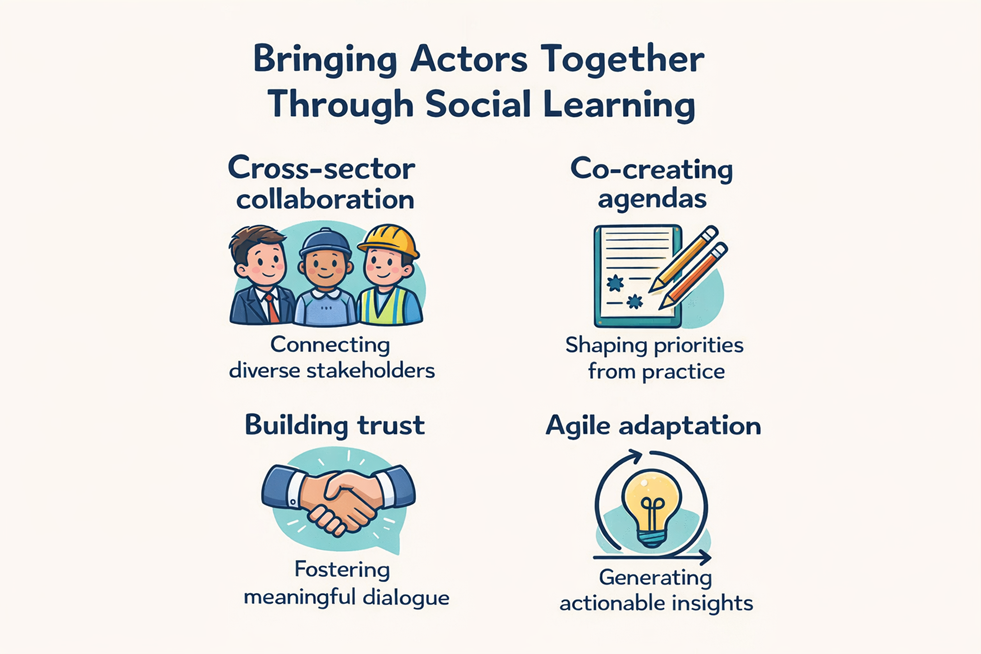
Image on Social Learning created by AI (Copilot accessed 19.02.2026)
Social learning helps connect across boundaries
Many organisations still divide people by role, hierarchy, or location. These divisions help the administration, but often create silos. Social learning breaks barriers by uniting people who care about the same issue, regardless of department or job. In these spaces, policymakers, practitioners, researchers, and frontline workers share lived experiences. This diversity is a strength, not a complication. It leads to trust. When people feel safe to speak honestly, they admit challenges, question assumptions, and explore new ideas together—something rare in formal meetings. This trust forms the basis for real collaboration.
How Groups Build Meaningful Agenda
A strong agenda is not just a to‑do list. Especially when we bring together different constituencies. Agenda can be built on a shared understanding of what matters most and what can realistically be achieved. Social learning helps create these agendas by starting from real experience rather than abstract plans. People bring stories from their daily work—the problems keeping them “up at night.” These insights help shape priorities that reflect actual needs. It is through real-life stories that the common agenda for tripartite/multilateral cooperation is shaped.
The agenda is therefore built with the group, not for them. Because participants help shape it, they feel ownership and are more committed to putting it into action. The agenda also evolves over time as new ideas emerge. It stays flexible, which is essential in fast‑changing environments.

Why Social Learning Works
Social learning succeeds because it taps into people’s natural motivation, according to Wenger-Trayner, during the 2-day onsite training on Social Learning. Participants join because the topic matters to them – not because they were told to attend. This creates energy and creativity. These conversations allow people to learn from mistakes without fear, test ideas quickly, and strengthen their understanding through shared language and tools. There is a range of easy-to-use facilitation tools (e.g., lean café/world café, debate, fishbowl…) to help different people and groups converse with each other.
What Changes When People Learn Together
Organisations that adopt social learning often see real improvements, as confirmed by Wenger-Trayner. Decisions become better informed, collaboration grows stronger, and learning becomes continuous instead of occasional. Participation becomes more inclusive, giving a voice to those closest to the ground. New ideas emerge more easily, and people feel part of a shared professional identity, improving morale and motivation.
A Strategic Asset for Today’s Challenges
Simply gathering people in a room isn’t enough. They need structures that help them learn from each other meaningfully. Social learning provides that structure. It turns groups into communities, conversations into shared understanding, and fragmented experiences into actionable plans. In a world defined by uncertainty, social learning is not just useful – it is essential.
When people connect through shared practice, reflect together, and co‑create their future, they build agendas that are meaningful, realistic, and capable of creating real change.
Liia Kaarlõp
About the author
Member of the ETF Team on Social Partners, on Skills Governance, and on Quality Assurance. Chair of the ETF Staff Committee. Secretary of the ETF-USF.