
Almost 1600 employees went on strike at the EPO, in response to the persistent salary and pension erosion, on 30.01.2026
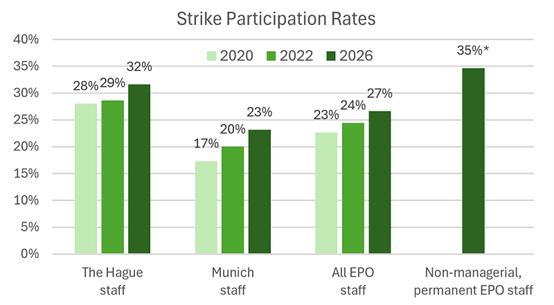
On Friday 30 January, 1577 employees went on strike across the different sites of the European Patent Office (EPO). This means 27% of EPO staff participated in the strike office wide, or an estimated 35%* of the non-managerial, permanent staff members. The strike has been called by the SUEPO union branches of Munich, The Hague and Berlin in response to the persistent salary and pension erosion. In the NL staff has already lost 7% since 2020 compared to Dutch national inflation.
The participation rate across the last three strikes, since 2020, all called in response to the persistent salary and pension erosion, has been steadily increasing.
Background
Until 2020 the Salary Adjustment Procedure (SAP) at the EPO was very similar to the salary adjustment procedure of the EU. It was based on two universally recognized guiding principles for International Organizations: the parallelism with salaries of national civil servants (Specific Indicators: SI) and the equivalence of purchasing power among staff in different countries (Purchasing Power Parity: PPP). These two coefficients where then multiplied by a measure of inflation (HICP) in a reference city to get the annual adjustment in the different places of employment.
This method guaranteed, across the different EPO sites, equal treatment of employees, equal pay for equal work, and it followed the wage evolution of national civil servants.
A biased financial study commissioned by the EPO in 2019 found that there was a hypothetical funding gap of 3.8 Bn Euros, despite a very healthy financial situation and enough funds in the Reserve Pension Fund (RFPSS) to cover for all future liabilities. Since it was found that this hypothetical funding gap could be compensated by the annual adjustments of the renewal fees and other adjustments, the administration decided to add a supplementary 2 Bn Euros buffer to the hypothetical gap for extra, unnecessary safety.
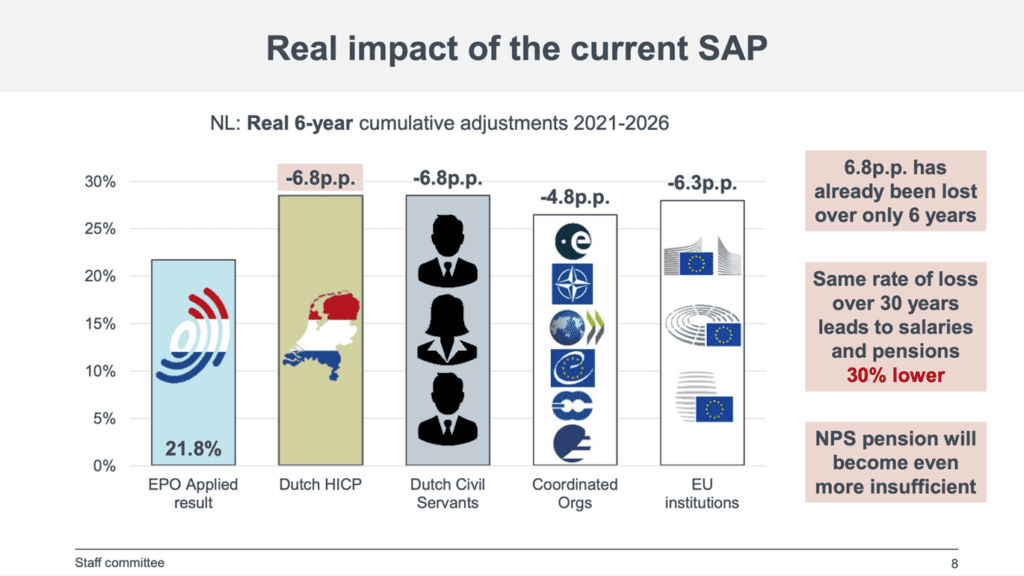
Consequently, in 2020, in order to cover this 2 Bn Euros extra “gap” over 20 years, the administration of the EPO introduced, against the will of the Staff representation, a new Salary Adjustment Procedure for the period 2020-2026 which, while substantially following the principles of the old procedure, added among other things, a sustainability clause, also called sustainability cap, which capped the annual adjustments at the Eurozone inflation + 0.2 %. The implementation of this capping mechanism introduced a severe distortion to the purchasing power parity among sites, and a sharp reduction of the annual salary adjustments in all sites. In the Netherlands, EPO staff has already lost circa 7% in real income since 2020, compared to Dutch national inflation. At the present rate, salaries and pensions will lose 30% over 30 years. If the pace of salary erosion over the past six years continues, the already insufficient monthly pension for the staff hired since 2009 in the New Pension Scheme (NPS) will steadily move towards the poverty line.
Over the last six years, the SUEPO trade union has actively supported litigation against the 2020 reform of the salary adjustment procedure: ca. 1300 individual appeals from EPO staff and pensioners have been filed against the method. The Internal Appeals Committee has already issued a unanimous positive opinion in favour of staff considering i.a. that the sustainability clause violated the principle of purchasing power parity and thus the underlying general principle of equal treatment. Regrettably, the President decided not to follow the opinion and the matter is now in front of the ILOAT.
At the same time, all the economic indicators of the EPO are in the green: all pension liabilities are covered and the EPO, a not-for-profit organisation, has been generating record annual surpluses. A 2023 financial study has found a surplus coverage of 4.2 Bn Euros and according to an actuarial study in 2025 the pension liabilities are covered at 100.3 % (now even higher).
Under pressure from some delegations in the Administrative Council, which would like to make some extra savings, the EPO administration now proposes a new Salary Adjustment Procedure for 2027-2032 which would be even more detrimental to staff than the present one. Instead of taking due note of the unanimous opinion of the Internal Appeal Committee and reverting to the old SAP, the EPO has decided to further depart from its recognised guiding principles. In the proposal now on the table there is no reference anymore to the parallelism with the salaries of the national civil servants. While it is not yet clear if this new proposal will respect the principle of purchasing power parity, it is evident that it will not fulfil the requirements of parallelism.
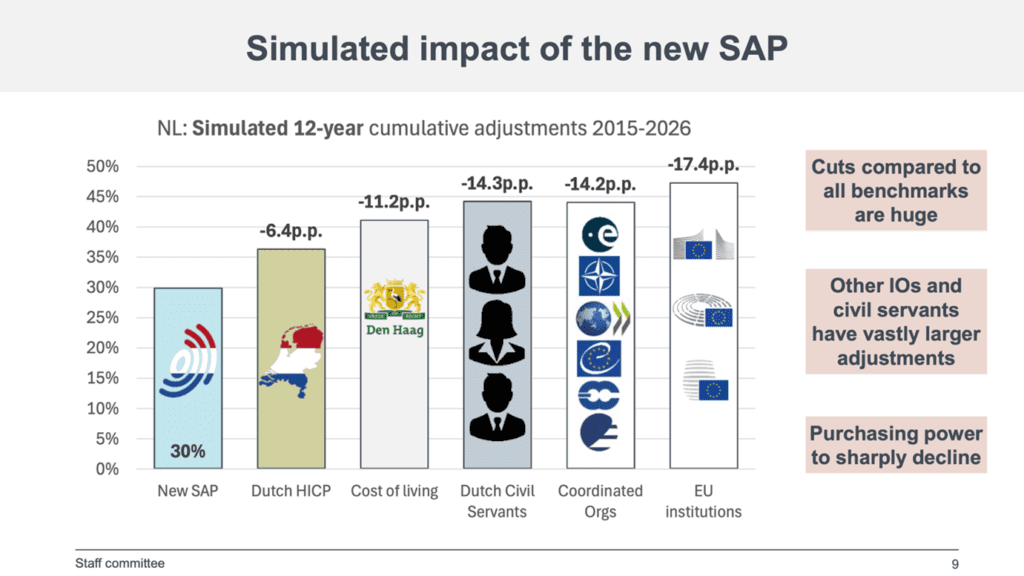
A simulated impact of the proposed new SAP (simulated over the 12 years 2015 – 2026) on the EPO salaries adjustments in the NL shows a cumulative loss of 17.4 % compared to the EU institutions, 14.2 % to the coordinated organisations and 14.3 % to the Dutch civil servants (see table below).
SUEPO call for Industrial Action
In coordination with SUEPO Munich, Berlin and Vienna, SUEPO The Hague drafted an Action Plan that was presented for discussion and vote during an Extraordinary General Meeting (EGM) on 27 January. The ballot results were 94% yes, 3% no, and 3% abstain. The other SUEPO branches have adopted very similar action plans.
The adopted plan combines:
- Warning strikes: on 30 January, 23 February and 19 March.
- Work-To-Rule: for all staff, this means working thoroughly, avoiding rushing or overtime, and refraining from voluntary projects.
- A further EGM: on 24 March to assess escalation.
- Potential high-frequency strikes: from April to June if the March Administrative Council adopts damaging orientations.
Staff showed readiness to defend purchasing power and institutional integrity. Continued erosion is unjustified and detrimental to recruitment, retention and reputation.
Roberto Righetti
Member of USF Bureau Fédéral